
Get Calls in 8–12 Weeks: Plumbing SEO Playbook for Plumbers
Plumbing SEO comes down to two things: owning your Google Business Profile and building service pages tight enough to win high-intent searches. The single highest-impact move you can make this week is fixing your core GBP fields and starting a steady review-collection habit. Do that first, and most plumbing companies see stronger map impressions and more calls within 8 to 12 weeks.
TL;DR:
- Improving core Google Business Profile fields and establishing a consistent review collection process can lead to stronger map impressions and more calls within 8 to 12 weeks.
- Focusing on relevant, high-intent keywords and building dedicated service and location pages with schema boost local relevance and conversion rates.
- Maintaining citation consistency and regularly auditing listings across directories can result in noticeable visibility improvements within 8 to 12 weeks.
- Technical SEO fixes, such as optimizing page speed and ensuring proper indexing, are crucial for ranking and can deliver measurable results within a few months.
- Assigning clear ownership of GBP updates and review requests accelerates local search performance more effectively than relying on multiple individuals or sporadic efforts.
Table of Contents
- What is plumbing SEO, and where do you start?
- Google Business Profile: exact fields to fix and in what order
- Review strategy that improves both ranking and conversion
- Service and location pages: structure, content and schema
- Keyword research: find high-intent plumbing queries and map them to pages
- Technical SEO essentials for plumbers
- Citation audit and NAP consistency: how to clean up listings
- Measurement, timelines and expected costs
- Content and conversion tactics that turn searchers into booked jobs
- OnLead’s practical playbook and proof points
- Publisher perspective: three priorities to lock in this week
- How OnLead helps plumbing businesses move up the Map Pack
- Sources
- FAQ
What is plumbing SEO, and where do you start?
Plumbing SEO is the practice of getting your business found in the Map Pack and organic search results when someone types “emergency plumber near me” or “water heater repair [city]” into Google. It is not the same as generic content marketing or a set of vague brand-building blog posts. It is a narrow, high-stakes game built around three levers: your Google Business Profile, your reviews, and your service pages.
Whitespark’s Local Search Ranking Factors research puts numbers on this. Google Business Profile signals represent a significant portion of local pack ranking weight, with review signals and on-page signals also contributing importantly. Proximity to the searcher remains the largest factor and is uncontrollable. What you can control is everything else, and that is where the leverage lives.
The standard industry term for this work is local SEO, and if you have seen “plumbing SEO” used interchangeably with “local search marketing” or “Map Pack optimization,” those all describe the same discipline applied to a plumbing business specifically. The tactics differ by trade, but the mechanics of local search do not.
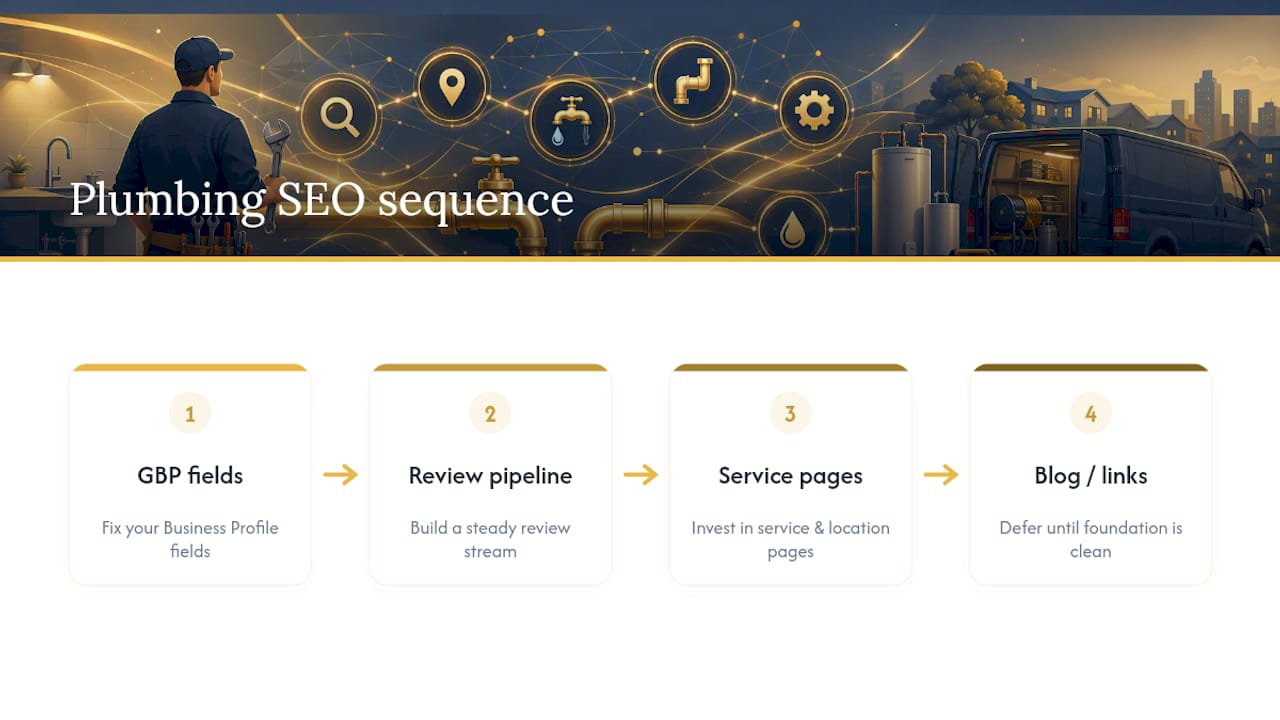
Here is the order of operations that actually works: fix your GBP fields, build a review pipeline, then invest in service and location pages. Skipping straight to blog content or link building before your profile is clean is one of the most common ways plumbers waste marketing budget.
Google Business Profile: exact fields to fix and in what order
Google’s own guidance says local rankings depend on relevance, distance, and prominence, and a complete, accurate profile is what feeds all three. Start here, in this order:
- Business name and primary category. Use your real, registered business name, no keyword stuffing (“Toronto’s Best 24hr Plumber Inc.” gets flagged and can hurt trust signals). Set your primary category to “Plumber,” not a broader label.
- Secondary categories. Add specific ones that match services you actually offer, such as “Drainage service” or “Water heater repair,” if they exist in Google’s list.
- Services section with real descriptions. Every listed service needs a short description using the language customers actually search, not internal jargon. “Burst pipe repair” beats “emergency mitigation services.”
- Hours, including emergency hours. If you run 24-hour emergency service, say so explicitly and set special hours for holidays.
- Service area. Set this to match where you can genuinely dispatch a technician within a reasonable window, not your entire metro region if you cannot cover it.
- Website link and photos. Confirm the link goes to a live, relevant page, not your homepage by default, and upload 10 to 20 real photos of trucks, technicians, and completed jobs.
A useful checklist for what Google actually confirms matters for plumbers separates real ranking fields from busywork agencies love to bill for. Geo-tagging photo files and posting three times a week rarely move rankings. They can support engagement, but treat them as optional polish, not priority.
Pro Tip: Answer every “Questions & Answers” entry on your profile within a day, even the odd or repetitive ones. Google increasingly surfaces short, direct answers in AI-driven search results, and a well-answered profile question can end up quoted verbatim in a search snippet.
Once the fields are complete, respond to every incoming review and question the same week they arrive. Fast responses are a behavioural signal, and they also close leads that a slow competitor would lose. For companies running HVAC alongside plumbing, the same field priority order applies almost line for line, which is worth knowing if you are managing more than one trade profile, as covered in this HVAC SEO guide.
Review strategy that improves both ranking and conversion
Review recency and velocity now matter more than raw review count. Profiles with a steady trickle of recent reviews consistently outrank and outconvert profiles that have more total reviews but nothing recent. A plumbing company with 40 reviews and five from the last month beats a competitor sitting on 200 reviews with nothing since last year.
Build a repeatable process instead of a one-time push:
- Ask within hours of job completion, while the technician’s name and the fix are still fresh in the customer’s mind. A next-day text beats a week-later email every time.
- Send a direct text link to your review page rather than routing people through email, since click-through rates on text links are consistently higher for home-service customers.
- Track monthly review velocity as a number you watch, not a total you chase. Five new reviews every month for a year beats fifty reviews in one week followed by silence.
- Reply to every review within two or three days. Name the actual service performed (“Glad we got that basement backup sorted before the weekend”) instead of a generic thank-you. Never stuff keywords into replies; Google and readers both notice.
- Flag fraudulent or clearly fake negative reviews through Google’s review-flagging tool the same day you spot them, and document the interaction in case you need to escalate.
Owner replies and review recency function as behavioural signals that correlate with stronger Map Pack placement, not just customer goodwill. Treat review management as a weekly task assigned to one specific person, not an occasional afterthought squeezed in between jobs.
Service and location pages: structure, content and schema
Your website’s job is to convert the searchers your GBP profile attracts, and thin, generic pages leak leads. Build a dedicated page for every core service (drain cleaning, water heater installation, sump pump repair) and a separate page for every city or region you genuinely service, with unique content on each. Duplicating one template across five cities with the city name swapped out is a thin-content problem that dilutes relevance for all five pages.
Title tags and H1s should follow a simple pattern: “[Service] in [City] | [Business Name],” for example “Drain Cleaning in Mississauga | Reliable Flow Plumbing.” That structure matches what people actually type into Google.
Each service page needs a few content blocks that do real work:
- A plain-language explanation of what the service involves and why a homeowner needs it
- A short walkthrough of typical job steps, so the customer knows what to expect
- Honest pricing ranges or at least a stated dispatch fee
- A compact FAQ answering the three or four questions customers ask most before booking
- A clear call-to-action with a phone number and booking option above the fold
Service pages built around job outcomes, pricing transparency, and “what to expect” sections consistently outperform long, generic blog posts at converting plumbing leads, because the person reading them is already close to booking, not browsing for general information.
On the technical side, add LocalBusiness schema to your site-wide markup and Service schema to each individual service page, specifying the service type, area served, and provider. This gives search engines a structured, unambiguous read on what you offer and where.
On-page signals account for roughly 19% of local ranking weight, according to Whitespark’s 2026 ranking factors research, which is nearly as much influence as your entire review profile. A handful of well-built service pages can outweigh a stack of thin ones.
Keyword research: find high-intent plumbing queries and map them to pages
Skip broad informational keywords like “how does a water heater work.” They attract researchers, not people ready to book a technician. Prioritize commercial and emergency intent instead.
- Filter for intent first, volume second. A low-volume term like “burst pipe emergency [city]” converts at a far higher rate than a high-volume term like “plumbing tips,” even though the search volume looks smaller on paper.
- Cluster similar queries together rather than treating each variation as its own page. “Water heater replacement,” “hot water tank installation,” and “water heater not working” often belong on one page targeting the same searcher intent.
- Map each cluster to a single page or GBP service. Assign “emergency plumber,” “drain cleaning,” and “water heater replacement” to their own dedicated service pages and list them as distinct GBP services, so the same language appears in both places.
Consistency between your GBP services list and your website’s service pages reinforces relevance signals on both ends. If your profile lists “sump pump installation” but your website only mentions it in a paragraph buried on your homepage, you are leaving a ranking signal on the table.
Technical SEO essentials for plumbers
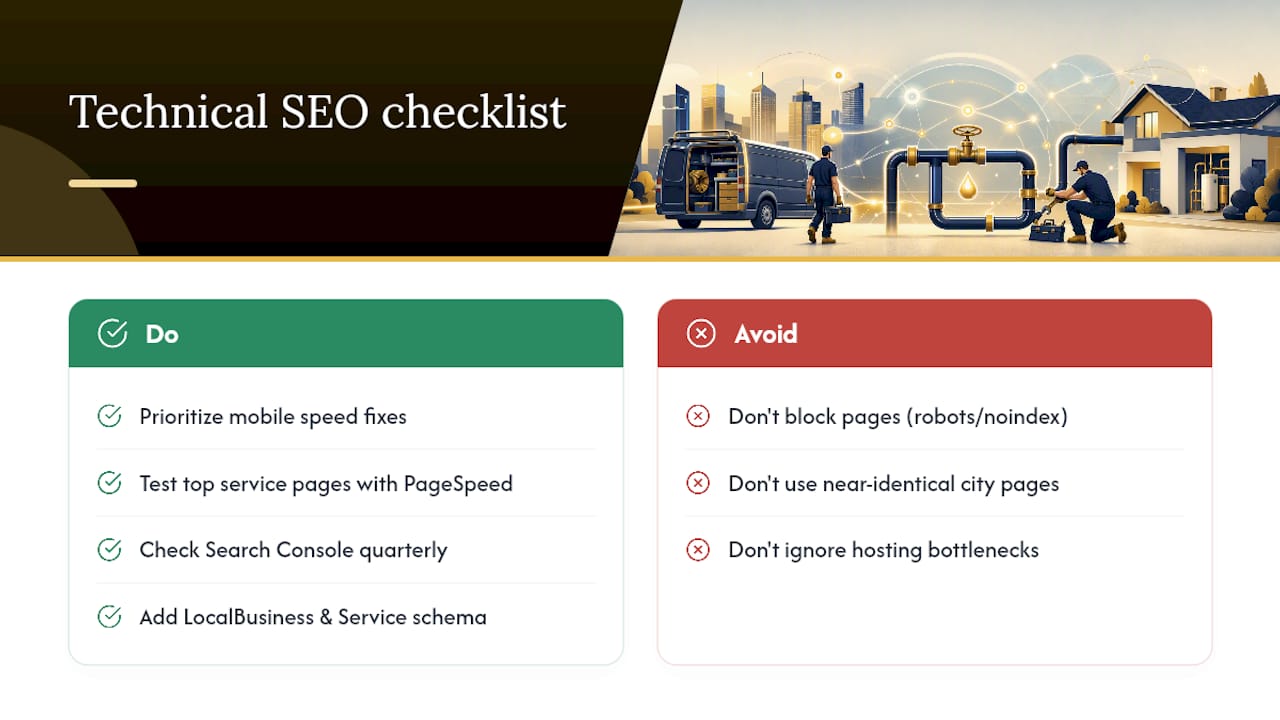
Most technical SEO problems that hurt plumbing companies are unglamorous fixes, not complex overhauls. Start with mobile performance: the majority of emergency plumbing searches happen on a phone, often from someone standing in a flooding basement, so a slow-loading service page costs you the call before it ever loads.
Run your top service pages through a page-speed test and fix the worst offenders first, since those pages carry the most search traffic and the most conversion pressure. Compress images, remove unused scripts, and confirm your hosting isn’t the bottleneck.
Confirm every important page is indexable. It sounds basic, but plumbers who switch website platforms or redesign their site sometimes end up with service pages accidentally blocked by a stray noindex tag or a forgotten robots.txt rule. Check Google Search Console for coverage errors at least once a quarter.
Watch for canonical tag conflicts and thin-content duplication, especially across location pages built from the same template. If two city pages are 90% identical, Google may treat one as a duplicate and suppress it from ranking, which quietly kills the exact pages meant to drive local relevance.
Add LocalBusiness schema site-wide and Service schema to individual service pages. This is a one-time technical task with a long payoff, and it costs little to implement correctly.
Citation audit and NAP consistency: how to clean up listings
Inconsistent name, address, and phone number data across the web makes Google distrust your profile, and that distrust can quietly suppress your Map Pack visibility even when your GBP profile itself looks perfect. Citation cleanup is one of the fastest wins available because it fixes a trust problem, not a content problem.
Run a citation inventory that compares your GBP listing, your website footer, and your top directory profiles (Yelp, Better Business Bureau, industry-specific directories, and your local chamber of commerce). List every discrepancy in a single spreadsheet, name, address, phone, and website URL for each source.
Prioritize corrections in this order:
- Fix your own website footer and contact page first, since that’s your source of truth
- Correct high-authority directories and your local chamber of commerce next
- Work through smaller or lower-traffic directories last
Schedule this audit twice a year, not once and done. Businesses that move, change phone systems, or rebrand often leave stale citations scattered across a dozen directories they forgot existed, and fixing those inconsistencies is frequently the fastest single lever for Map Pack improvement, sometimes producing visible gains within 8 to 12 weeks.
Measurement, timelines and expected costs
Track five numbers, not fifty. GBP impressions, profile views, clicks-to-call, organic traffic to your service pages, and booked jobs attributable to SEO. Everything else is noise unless you are running a large multi-location operation.
Timelines vary by task type:
- GBP and citation fixes: visible gains in 4 to 12 weeks, since these correct trust and completeness signals Google already tracks
- Organic service-page growth: 3 to 6 months, because new or rewritten pages need time to earn authority and get indexed properly
- Review velocity improvements: compounding gains over 6 to 12 months as recency and consistency build
Cost structures for plumbing SEO typically break into three bands: a one-off website or service-page build cost, an ongoing monthly fee covering hosting, maintenance, and review automation, and separately, paid advertising when you need immediate volume while organic momentum builds. Industry analysis of 2026 local ranking trends shows home-service businesses that pair GBP and review work with organic service pages see faster returns than those relying on link-building campaigns alone, which take longer to pay off and cost considerably more per lead in most trade markets.
Content and conversion tactics that turn searchers into booked jobs
A searcher landing on your drain cleaning page is not browsing. They are deciding whether to call you or the next result down. Every element on that page should reduce hesitation, not add reading time.
- State a real price range or dispatch fee, even a wide one, since vague “call for pricing” pages lose trust compared to competitors who show a number
- Add a short “what to expect” block describing the visit from arrival to cleanup
- Include before-and-after photos of comparable jobs, not stock photography
- Put a click-to-call button and a scheduling widget above the fold, visible without scrolling
- Show two or three review snippets directly on the page, pulled from your GBP reviews
Pro Tip: Write service page content in short, scannable blocks of two or three sentences each. A homeowner standing over a leaking pipe with their phone in hand is not going to read six paragraphs before calling. Give them the answer and the phone number fast.
Skip the generic 800-word blog post format for these pages entirely. Job-focused content blocks with pricing and process details consistently convert better than long-form articles for pages built to capture high-intent, ready-to-book traffic.
OnLead’s practical playbook and proof points
OnLead builds and runs these exact systems for HVAC, plumbing, electrical, and roofing contractors across Ontario, and the first 72 hours of any new client relationship follow the same sequence: a full GBP audit against Google’s confirmed ranking fields, a review-automation workflow set up to text customers within hours of job completion, and a service-page plan mapped against the keyword clusters that actually convert in that contractor’s service area.
That sequencing isn’t arbitrary. It mirrors the ranking-weight distribution Whitespark documents, GBP and reviews first, page-level content second, because that order produces visible movement fastest.
Whether a DIY approach or an agency makes more sense depends mostly on time, not budget. A plumbing owner with a spare evening a week and some patience can execute the GBP and review steps in this guide without outside help. The service-page builds, schema implementation, and ongoing citation audits take longer to do well, and that’s usually the point where owners bring in outside support rather than losing a weekend to it every quarter.
Publisher perspective: three priorities to lock in this week
If you take one thing from this guide, make it this: pick a single person, owner or office manager, who owns GBP updates and review requests every week without exception. Diffuse responsibility is why most plumbing profiles go stale. Second, set a review-ask workflow that fires automatically after every completed job, not one that depends on someone remembering. Third, schedule one service page for a rewrite this month, starting with whichever service generates your highest-margin jobs.
These three moves produce the fastest visible lift because they target the two ranking factors you actually control: profile completeness and review behaviour. Everything else compounds slower. Escalate to an agency once you notice the GBP and review basics are solid but service-page traffic still isn’t converting, that’s usually a content and schema problem, not a review problem, and it needs different expertise.
— OnLead
How OnLead helps plumbing businesses move up the Map Pack
You get personalized support for your GBP optimization, review automation, and service-page strategy, with most campaigns launched quickly instead of the multi-week onboarding typical of larger shops. That speed matters when every week without a clean GBP profile is a week of lost emergency calls to a competitor who fixed theirs already.
A free audit compares your current GBP setup, citations, and service pages against the ranking-weight priorities covered in this guide, and flags exactly where you’re leaking visibility. From there, OnLead can handle GBP optimization, service page builds, review automation, and Local Services Ads setup as complementary paid presence while your organic pages mature. If you run HVAC or electrical work alongside plumbing, the same contractor marketing approach applies across trades.
Request a free audit through OnLead’s lead generation page and see exactly which GBP fields and pages are costing you calls right now.
Sources
This guide draws on Whitespark’s Local Search Ranking Factors report for GBP and review weightings, Google’s own Business Profile support documentation for confirmed ranking inputs, and industry analysis from Endigita and Tradeloper on 2026 Map Pack and review trends for home-service businesses. Guidance on choosing outside help comes from ALIGN’s agency-selection framework.
- Whitespark — Local Search Ranking Factors 2026
- Google Business Profile Help — How search works for businesses and places
- Tradeloper — Local SEO & Google review statistics for home-service businesses (2026)
FAQ
What does SEO stand for in a plumbing or construction context?
SEO stands for search engine optimization, the practice of improving a website and business profile so it ranks higher in search results and the Map Pack for relevant local searches.
How much does SEO cost in Canada?
Costs vary widely by scope, but plumbing SEO typically involves a one-off website or service-page build cost plus an ongoing monthly fee for maintenance, review automation, and citation management, with pricing custom-quoted after a free audit.
What is the 135 rule in plumbing?
The “1-3-5 rule” refers to plumbing fixture drain sizing conventions, not an SEO or marketing concept. It has no connection to plumbing SEO strategy.
What is the best way to advertise as a plumber?
The strongest combination is a complete, accurate Google Business Profile paired with a steady review pipeline and dedicated service pages, complemented by Local Services Ads for immediate lead volume while organic rankings build over 3 to 6 months.
How long does plumbing SEO take to show results?
GBP and citation fixes typically show measurable gains in 4 to 12 weeks, while organic service-page traffic growth usually takes 3 to 6 months to build meaningfully.