
Fix Voice Search Losses in 30–90 Days: NAP Consistency for Contractors
NAP consistency means your business name, address, and phone number match, word for word and digit for digit, everywhere they appear online. Get it wrong and Google, Bing, Apple, and AI answer engines all lose confidence in which listing to trust. The fix starts today: write down one canonical version of your name, address, and phone, then make your Google Business Profile match it exactly before touching anything else.
TL;DR:
- Correcting NAP data on authoritative platforms like Google, Apple, and Bing leads to faster ranking improvements and more frequent local pack appearances.
- Common NAP issues include suite number mismatches, phone formatting errors, address abbreviations, inconsistent business names, and duplicate listings.
- Fixing cascade effects from major sources to smaller directories, with regular audits every 90 days or after any business change, maintains long-term accuracy.
- Most ranking benefits become visible within 30 to 90 days after corrections, with Google updates usually faster than smaller directory listings.
Table of Contents
- What does NAP consistency cover today?
- Why nap consistency matters for rankings and AI answers
- What are the most common NAP inconsistencies?
- How to audit nap consistency step by step
- How do you fix and maintain NAP problems long term?
- How long does it take to see results after fixing NAP?
- OnLead’s practical checklist for trades businesses
- Why NAP consistency is a maintenance task, not a one-time project
- How OnLead keeps your NAP consistent and your phone ringing
- Sources
- FAQ
What does NAP consistency cover today?
NAP consistency used to mean matching a website footer to a Yellow Pages listing. Now it spans a much wider set of places, and missing one weakens the rest.
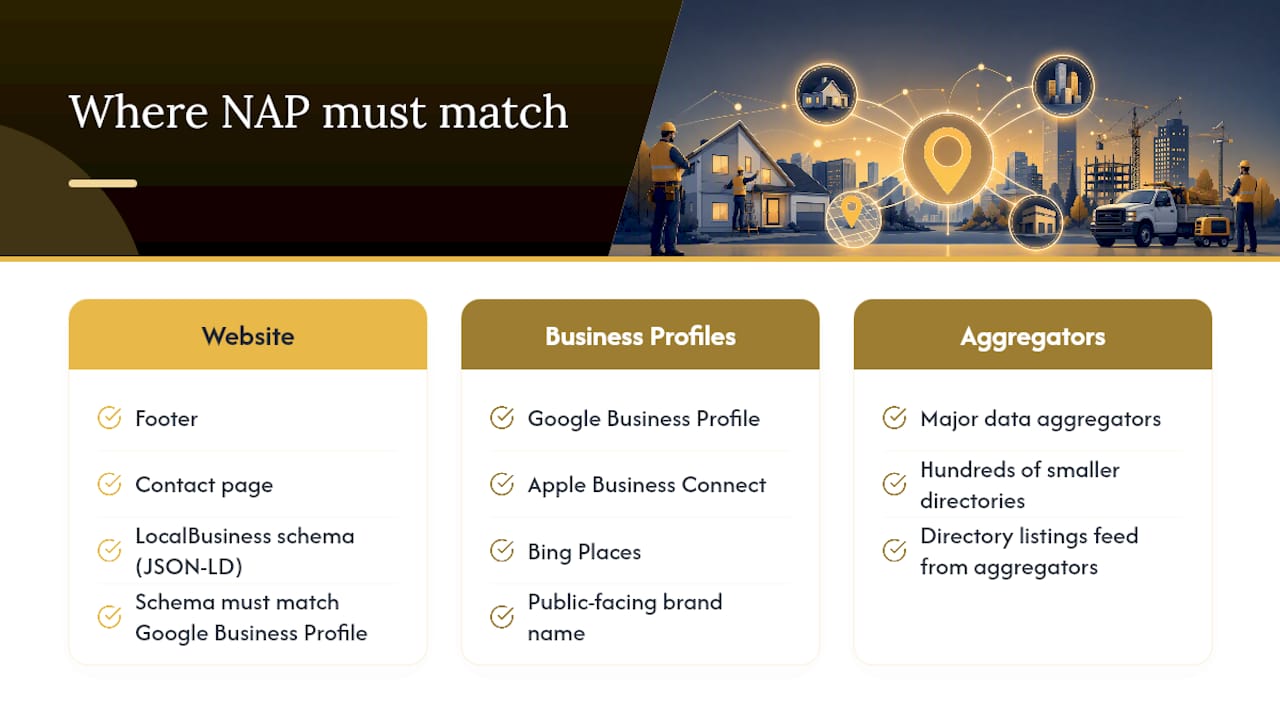
Start with your own site: the footer, the contact page, and the LocalBusiness schema markup embedded in your page code. Then move outward to Google Business Profile, Apple Business Connect, Bing Places, and the major data aggregators that feed hundreds of smaller directories. BrightLocal defines NAP as the same name, address, and phone number appearing across your website, your profile, and directory listings, and notes that inconsistencies reduce a search engine’s confidence in which record is correct.
Schema markup deserves special attention because it’s the version search engines read as machine-readable fact. The LocalBusiness @type in your JSON-LD should carry the exact same street address, phone format, and business name as your Google Business Profile. A mismatch here does more damage than a typo buried in an old directory listing nobody visits.
Not every difference matters equally. “Street” versus “St.” rarely causes trouble, since search engines normalise common abbreviations. What does cause trouble: a different suite number, a disconnected phone line, or a legal name that doesn’t match your public-facing brand. Those inconsistencies confuse verification systems and can stall a Google Business Profile review indefinitely.
Why nap consistency matters for rankings and AI answers
Citation consistency isn’t a nice-to-have footnote in local SEO. It’s a measurable ranking input. Whitespark’s local search ranking factors research tracks specific technical signals, including whether your HTML NAP matches your Google Business Profile NAP and whether your schema markup matches both. Agencies that audit for local pack visibility check these fields directly because they correlate with ranking position.
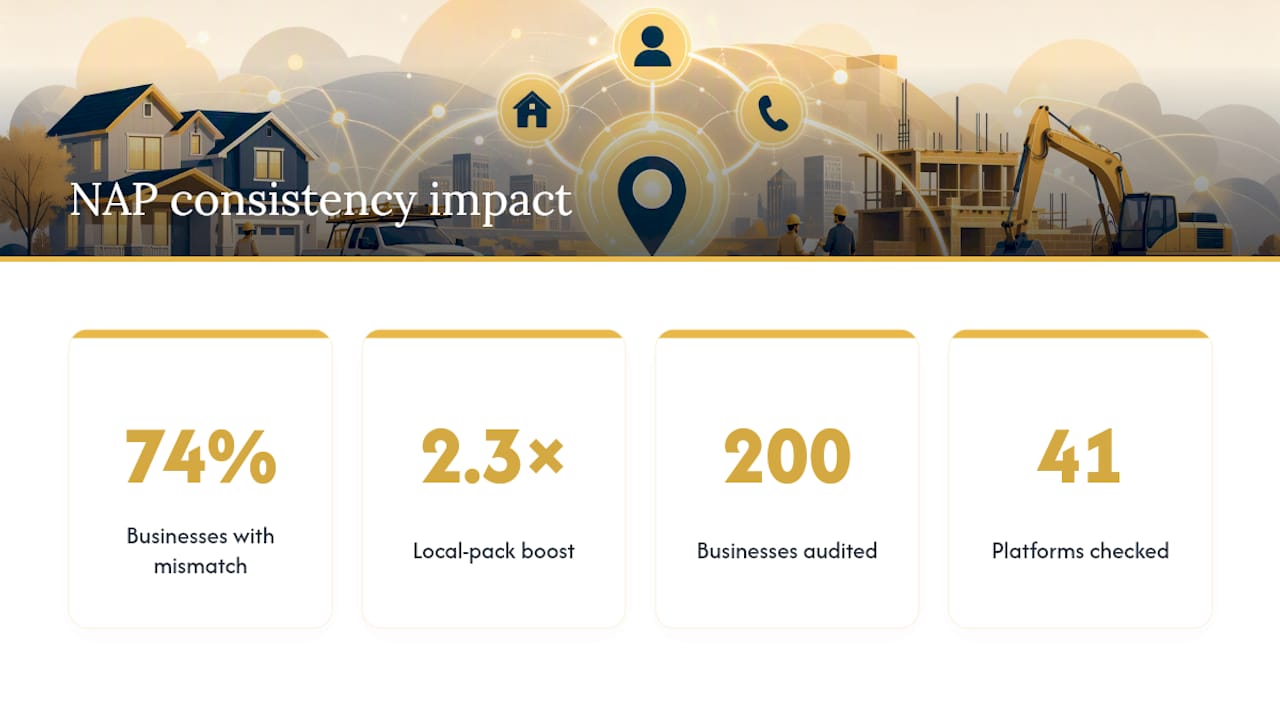
The numbers behind this are stark. An audit of 200 businesses across 41 platforms found that A large share of audited businesses had at least one NAP mismatch, and businesses with fully consistent listings appeared in the local pack about 2.3 times more often than competitors with mismatched data.
Statistic Callout: Nearly three out of four businesses audited had at least one NAP mismatch somewhere online, and full consistency was linked to a 2.3x higher local pack appearance rate compared to inconsistent competitors.
That gap matters even more now that AI and voice search have entered the picture. Voice assistants and AI answer engines don’t read ten listings and pick the best one. They favour a single, verified answer, and an inconsistent business is easier to skip than to reconcile. If ChatGPT or a voice assistant finds three different phone numbers tied to your business name, the safest move for that system is to omit you rather than guess. Beyond rankings, a wrong phone number or outdated address costs you real customers who show up at the wrong strip mall or dial a disconnected line. Industry data on local SEO shows citation consistency controls a measurable share of local pack ranking weight, and a large share of small businesses still carry inconsistencies across major directories.
What are the most common NAP inconsistencies?
Most NAP problems fall into a handful of repeatable patterns. Once you know what to look for, spotting them across your own listings takes an afternoon, not a week.
- Suite and unit mismatches: “Unit 4” on your website, “Suite 4” on Yelp, and no unit number at all on an old directory listing.
- Phone formatting drift: (416) 555-0134 on Google, 416.555.0134 on Facebook, and a call-tracking number nobody remembers to update everywhere.
- Address abbreviation chaos: “123 Main St.” in one place, “123 Main Street” in another, plus an outdated postal code from before a move.
- Business name variants: your legal name on some listings, your DBA or trade name on others, sometimes with “Inc.” or “Ltd.” tacked on inconsistently.
- Duplicate listings: an old Google Business Profile from a previous owner or address that never got merged or closed.
Call-tracking numbers deserve their own warning. Swapping in a tracking number for ad campaigns is smart for measuring calls, but if that number replaces your primary listed number on Google Business Profile without a clear plan to revert it, you’ve just broken your own citation consistency for the sake of a reporting dashboard.
Pro Tip: Keep a single “canonical” phone number listed everywhere for NAP purposes, and route call tracking through a secondary number visible only in ads, not baked into your core listings.
How to audit nap consistency step by step
An audit doesn’t need to be complicated, but it does need to be systematic. Skipping steps is how businesses end up with the same suite-number error on twelve different sites.
- Build a canonical NAP document with the exact name, full address (including suite number), and phone number you want everywhere. Treat this as your single source of truth.
- Check Google Business Profile first. It carries the most ranking weight and feeds many downstream services.
- Check Apple Business Connect and Bing Places next, since both power map results and voice queries on their respective platforms.
- Search your business name plus city on Google to surface old, duplicate, or “ghost” listings you may have forgotten about.
- Review your top five industry directories relevant to your trade, whether that’s HVAC, plumbing, electrical, or roofing.
- Check aggregator records (the services that feed hundreds of smaller directories at once) since fixing them cascades downstream automatically.
- Set an audit calendar: run a full pass quarterly, and immediately after any address change, phone swap, or rebrand.
For scale, citation-checking tools can flag mismatches across dozens of listings in minutes, though a manual spot check on Google Business Profile, Apple, and Bing still catches things automated tools miss, like a wrong suite number buried in a description field. Whitespark’s own ranking factors work treats these HTML-to-GBP and schema-to-GBP checks as standard audit items, not optional extras.
How do you fix and maintain NAP problems long term?
Fixing NAP issues works best in a specific order: authoritative sources first, aggregators second, then your website’s technical markup.
Start with Google Business Profile, since it’s the record most other systems reference. Verify ownership, then correct the name, address, and phone fields directly. Do the same for Apple Business Connect and Bing Places, both of which have their own verification flows that can take a few days to process.
Aggregators like Data Axle, Foursquare, and Neustar deserve priority because a single correction there often propagates to dozens of smaller directories without any further work on your part. This is genuinely the highest-leverage fix available: correcting a source aggregator cascades downstream automatically, saving you from manually editing the same fix fifty times over.
On your website, make sure your LocalBusiness JSON-LD schema matches your Google Business Profile exactly, field for field. If you operate multiple locations, use a unique @id for each location’s schema block so search engines don’t accidentally merge or confuse them.
- Update your canonical NAP document the moment anything changes: new phone line, new address, rebrand, or ownership transfer.
- Notify aggregators and re-verify GBP within days of any change, not months later.
- Give each physical location its own Google Business Profile and its own phone line rather than sharing one number across multiple sites.
- Run a follow-up audit 30 days after any correction to confirm it actually propagated.
Pro Tip: If you operate more than one location, resist the urge to route all calls through one main office number. It looks efficient internally, but it creates exactly the kind of NAP conflict that confuses both customers and search engines.
How long does it take to see results after fixing NAP?
Corrections don’t show up overnight. Most propagation happens within 30 to 90 days, depending on how quickly aggregators process updates and how many directories pull from them. Google Business Profile changes tend to reflect fastest, often within a couple of weeks, while smaller directory sites can lag behind by a month or more.
Watch four metrics to judge whether the cleanup worked: how often you appear in the local pack for target searches, Google Business Profile impressions and calls, phone-tracking conversions tied to those calls, and whether AI or voice assistants start surfacing your business in spoken answers. Run a before-and-after audit at the 30 day and 90 day marks and compare local pack frequency directly. Given that full consistency correlates with 2.3 times more local pack appearances, that single number makes for a clean before-and-after story for any stakeholder asking about return on effort.
OnLead’s practical checklist for trades businesses
A canonical NAP template should be built into every website project: it should live in the footer, the contact page, and the LocalBusiness schema, all pulling from one source so nothing drifts apart later. For HVAC, plumbing, electrical, and roofing clients, the priority order is always the same:
- Verify and correct Google Business Profile first, since it carries the most ranking weight.
- Push corrections through Apple Business Connect and Bing Places within the same week.
- Fix aggregator records so downstream directories update without manual chasing.
- Monitor local pack rank and GBP call volume monthly, reporting back to the client on what moved and why.
Client responsibility stays simple: flag any address, phone, or name change the moment it happens, since a two week delay in reporting a move often turns into a two month delay in fixing the citations tied to it.
Why NAP consistency is a maintenance task, not a one-time project
NAP issues come back. Aggregators re-import old data, employees edit listings without asking, and every business change (a new suite, a rebrand, a merger) reopens the door to mismatches. A single owner running quarterly checks costs far less than the ranking damage a forgotten duplicate listing causes six months later. Every other local marketing effort, from Google Ads to review generation, rests on the assumption that your basic contact data is right.
— OnLead
How OnLead keeps your NAP consistent and your phone ringing
Onlead is the alternative to hiring separate freelancers for your website, your citations, and your Google Business Profile: one team handles all three under a single canonical record, so nothing drifts apart the way it does when three different people touch three different platforms. That work sits inside OnLead’s core services, which cover Google Business Profile optimization, citation and schema management, and ongoing monitoring built specifically around HVAC, plumbing, electrical, and roofing businesses in Ontario.
Every project should start with clients working directly with the founder, and campaigns typically launch quickly after the initial audit, with no long-term contracts and accounts staying in your name. If your listings haven’t been checked in the last quarter, or you’ve moved, rebranded, or swapped phone numbers recently, start with a free audit through OnLead’s services page and get a clear picture of where your NAP data stands today.
Sources
- What is NAP in Local SEO? | BrightLocal
- Local search ranking factors — Whitespark
- NAP Consistency Checker 2026: Local Citation Audit | Backlynk
- Local SEO Statistics 2026: Ranking Factors, GBP & ROI Data | Biziq
FAQ
What is NAP consistency?
NAP consistency means your business name, address, and phone number appear identically across your website, Google Business Profile, and every directory listing. BrightLocal notes that inconsistencies reduce a search engine’s confidence in which listing is accurate, which can lower local rankings.
How do I check NAP consistency across my listings?
Start by building a canonical NAP document, then manually check Google Business Profile, Apple Business Connect, and Bing Places against it. Citation-checking tools can scan dozens of directories at once, but a manual review still catches issues like a wrong suite number that automated scans sometimes miss.
How can I improve NAP consistency for my business?
Fix authoritative sources first (Google Business Profile, Apple, Bing), then correct the data aggregators that feed smaller directories, since aggregator corrections cascade downstream automatically. Update your website’s schema markup to match, and audit quarterly or after any business change.
What does NAP stand for in SEO?
NAP stands for name, address, and phone number, the three core pieces of contact information search engines use to verify and rank local businesses. It’s a foundational input for local pack rankings and for how AI and voice assistants decide which business to recommend.
How long does it take to see ranking improvements after fixing NAP?
Most corrections propagate within 30 to 90 days, with Google Business Profile updates typically reflecting faster than smaller directory listings. Businesses with fully consistent NAP data appear in the local pack roughly 2.3 times more often than those with mismatches, which gives you a clear metric to track before and after cleanup.