
Stop Wasting Ads: Contractor Budgets That Fix Capture in 30–90 Days
Set your marketing budget within typical ranges based on your business stage: lower percentages for maintenance, higher for growth, and highest when new or re-launching, though specific percentages vary by company and context. But percentages come second. Before you increase ad spend, fix your lead capture: your Google Business Profile, review flow, website, and follow-up process. Track two numbers above everything else: cost per lead (CPL) and customer acquisition cost (CAC). A contractor marketing strategy that skips this order burns cash on ads that leak leads out the bottom.
TL;DR:
- Most contractors should allocate 6-10% of revenue for marketing during growth phases, with higher percentages needed when launching or rebranding.
- Prioritize fixing lead capture systems and Google Business Profile before increasing ad spend to prevent leaking leads and wasting budget.
- Use a capture-first framework to ensure traffic is converted efficiently, focusing on tracking, reviews, website trust, and follow-up before paid channels.
- Monitor key metrics monthly, especially CAC and CPL, and only scale channels when acquisition costs stay below the average project gross profit for at least three months.
- Hold back 5-10% of the marketing budget as a reserve for urgent opportunities or emergencies, and include offline tactics like yard signs and local events within the overall budget.
Table of Contents
- Quick rules of thumb: percent-of-revenue bands and when to use them
- Budget order: capture-first framework and checklist
- Channel allocation and sample monthly budgets (practical examples)
- How to calculate your budget from revenue and goals (workbook steps)
- Measure and decide: the contractor scorecard to run monthly
- Tools, calculators and low-cost modelling options
- OnLead practitioner checklist: 30–90 day fixes that make budget work
- Setting aside budget for unexpected marketing opportunities or emergencies
- Integrating offline marketing tactics and their budgeting considerations
- Author perspective: common mistakes and a behavioural nudge
- How OnLead can execute your contractor budget into booked jobs
- Sources
- FAQ
Quick rules of thumb: percent-of-revenue bands and when to use them
Most contracting businesses fall into one of three stages, and each one calls for a different slice of revenue.
- Maintenance (3–5%): You’re steady, referrals are strong, and you just need to keep the pipeline full without chasing growth.
- Growth (6–10%): You’re actively pushing for new volume, opening a service area, or adding crews and need fresh demand to match capacity.
- New or re-launch (8–12%): You’re building brand recognition and owned assets (reviews, website authority, a tracked phone number) from close to zero.
Construction companies aiming to grow commonly land in that 5–10% range, while businesses holding steady tend to spend less, according to BSPKN’s 2026 benchmarking. Company size and seasonality shift where you land inside a band, not whether the band applies.
Here’s the trap: spending at the high end of any band without a working conversion system just means you pay more per booked job, not fewer wasted leads. The percentage only works once the plumbing behind it is fixed.
Budget order: capture-first framework and checklist
Every contractor marketing budget should follow the same sequence, and it has nothing to do with which ad platform is trendy this year. ProTradeHQ’s staged budget framework lays out the logic clearly: spend on capture before you spend on attention.
- Lead capture and tracking — a dedicated call tracking number, a quote form that actually works on mobile, and missed-call text-back so no lead goes cold.
- Google Business Profile and reviews — an optimized profile and a steady review request cadence build the trust signal homeowners check first.
- Website trust fixes — mobile speed, clear calls to action, and real project photos instead of stock imagery.
- Follow-up systems — estimate follow-up templates and a database reactivation sequence for old leads who never booked.
- Paid channels — only once the first four convert at a reasonable rate.
Pro Tip: Run five test calls to your own business number before you spend a dollar on ads. If your team misses even one, that’s the leak ads will pour money into.
Channel allocation and sample monthly budgets (practical examples)
Once your capture systems work, split your budget across channels based on your stage, not on what a competitor is doing. Local SEO and your website should carry more weight early, since they build a durable pipeline; paid channels should carry more weight once you need volume fast.
Local SEO retainers in competitive trades commonly run $1,500 to $3,500 a month, and Local Services Ads leads for home services average around $53 apiece, per Contractor Guide Pro’s 2026 cost benchmarks. Those figures should anchor your line items, not a guess.
Seasonality matters too. Roofing, landscaping, and exterior trades should front-load spend two to three months ahead of peak season and hold a variable pool to pull back once demand outpaces crew capacity.
How to calculate your budget from revenue and goals (workbook steps)
Reverse-engineering your number takes fifteen minutes with last year’s numbers in front of you.
- Pull your trailing 12-month revenue. Say it’s $1,200,000.
- Set a growth goal. A 20% increase means you need $240,000 in new revenue.
- Separate new revenue from repeat and referral revenue, since your marketing budget should only need to generate the new portion. FreeAgency’s calculator methodology walks through this split with worked case studies across different contractor sizes.
- Pick your percent band (say 8% for a growth push) and apply it to total revenue: $96,000 annually, or $8,000 a month.
- Split that into a fixed floor (SEO, GBP, website hosting, roughly 60%) and a flexible pool (paid ads and testing, roughly 40%) you can adjust monthly.
Copy this into a spreadsheet and rerun it every quarter as revenue shifts.
Measure and decide: the contractor scorecard to run monthly
Run this scorecard on the first of every month, before you touch next month’s spend: leads by source, phone versus form fills, booked estimates by source, closed jobs by source, CAC, CPL, and gross-profit ROI per channel to have a solid base for measuring marketing ROI and adjusting budgets.
The biggest measurement mistake contractors make is blending ad-driven revenue with referral and repeat revenue into one ROAS number. That hides which dollars actually worked. Isolate paid-acquisition revenue separately, since folding in business you’d have gotten anyway inflates your apparent return and hides underperforming channels.
- Scale a channel when CAC sits comfortably under your average job’s gross profit for three straight months.
- Fix capture first if CPL looks fine but booked-estimate rate is low.
- Pause a channel that shows rising CPL with flat close rates for two months running.
Tools, calculators and low-cost modelling options
You don’t need custom software to model this. A basic spreadsheet or an interactive budget calculator built for home improvement contractors will convert your percent band into monthly line items and flag which channel needs attention.
For execution, low-cost tools cover most of the capture-first checklist:
- A call tracking number and missed-call text-back service (often under $50 a month).
- An automated review request tool tied to your CRM or invoicing software.
- A simple CRM to track leads by source, even a basic spreadsheet if you’re under 20 leads a month.
Whatever calculator you use, make sure it separates new customer revenue from repeat and referral revenue. A model that blends the two will always overstate what your ad spend is actually doing.
OnLead practitioner checklist: 30–90 day fixes that make budget work
Before an agency touches a client’s ad account, the first 72 hours go toward capture, not clicks: cleaning up the Google Business Profile, turning on a review request flow, and fixing the one landing page most likely to lose mobile visitors.
That order isn’t arbitrary. Paid ads multiply an already-working conversion path; they don’t repair a broken one. Fixing the foundation first is what makes every ad dollar afterward count.
- Audit and correct Google Business Profile categories, hours, and service areas.
- Turn on automated review requests after every completed job.
- Fix the single highest-traffic landing page for mobile load speed and a visible call button.
- Add call tracking so every lead source is attributable from day one.
- Build one follow-up sequence for quoted-but-not-booked customers.
Setting aside budget for unexpected marketing opportunities or emergencies
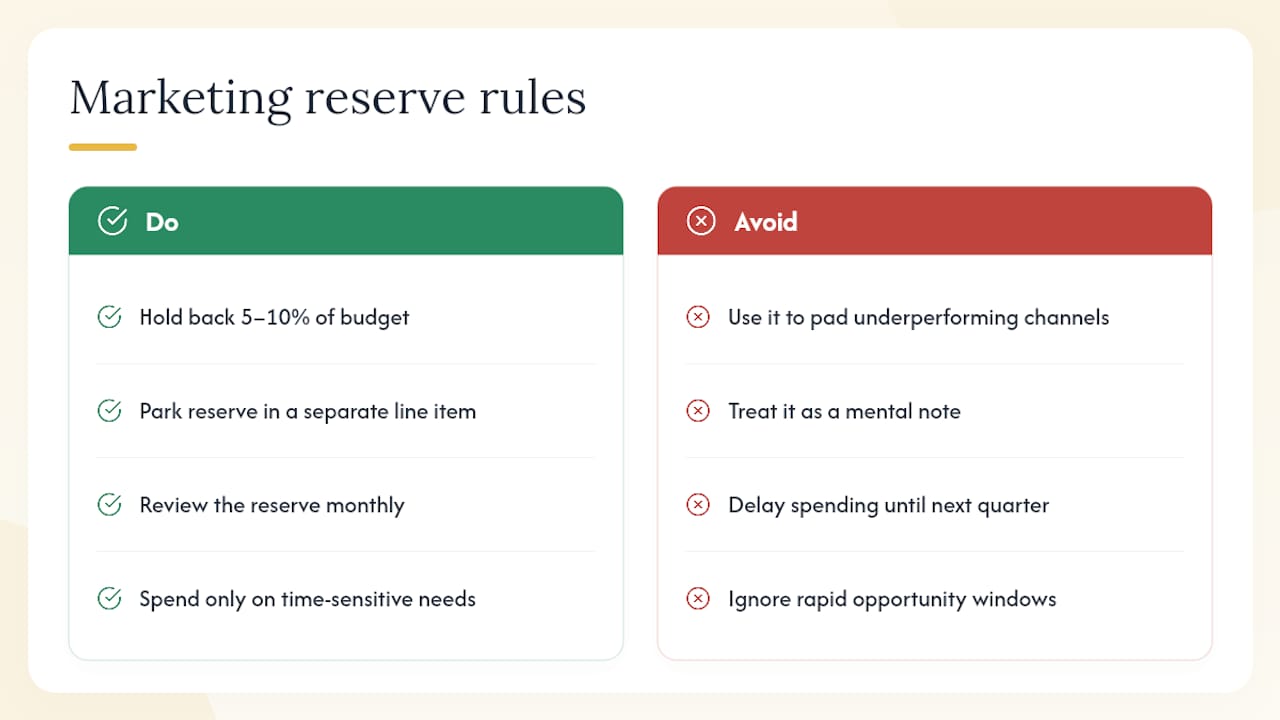
A fixed monthly budget with zero flexibility leaves you unable to react when a real opportunity or a real problem shows up. Hold back 5–10% of your total marketing budget as an uncommitted reserve, separate from your planned channel spend.
This reserve covers two very different situations. The first is opportunity: a competitor closes down and their reviews and search traffic go up for grabs, a local news story mentions your trade and search volume spikes, or a storm event creates sudden roofing or restoration demand in your service area. Contractors who can move within days, boosting ad spend or pushing a targeted campaign, capture disproportionate volume during these windows. Contractors waiting on next quarter’s budget approval miss it entirely.
The second is defence. A negative review cluster needs a rapid response campaign. A Google algorithm update tanks your local rankings overnight and you need a short-term Local Services Ads push to cover the gap while your SEO recovers.
Keep this reserve genuinely separate, not just a mental note. Park it in a distinct line item you review monthly, and set a rule for yourself: it only gets spent on something time-sensitive, not on padding an underperforming channel that just needs patience. If you haven’t touched it in a quarter, that’s fine. That’s what a reserve is for.
Integrating offline marketing tactics and their budgeting considerations
Digital gets most of the attention in any contractor marketing strategy, but offline tactics still earn a place in the budget, particularly for trades with strong neighbourhood visibility like roofing, landscaping, and general contracting.
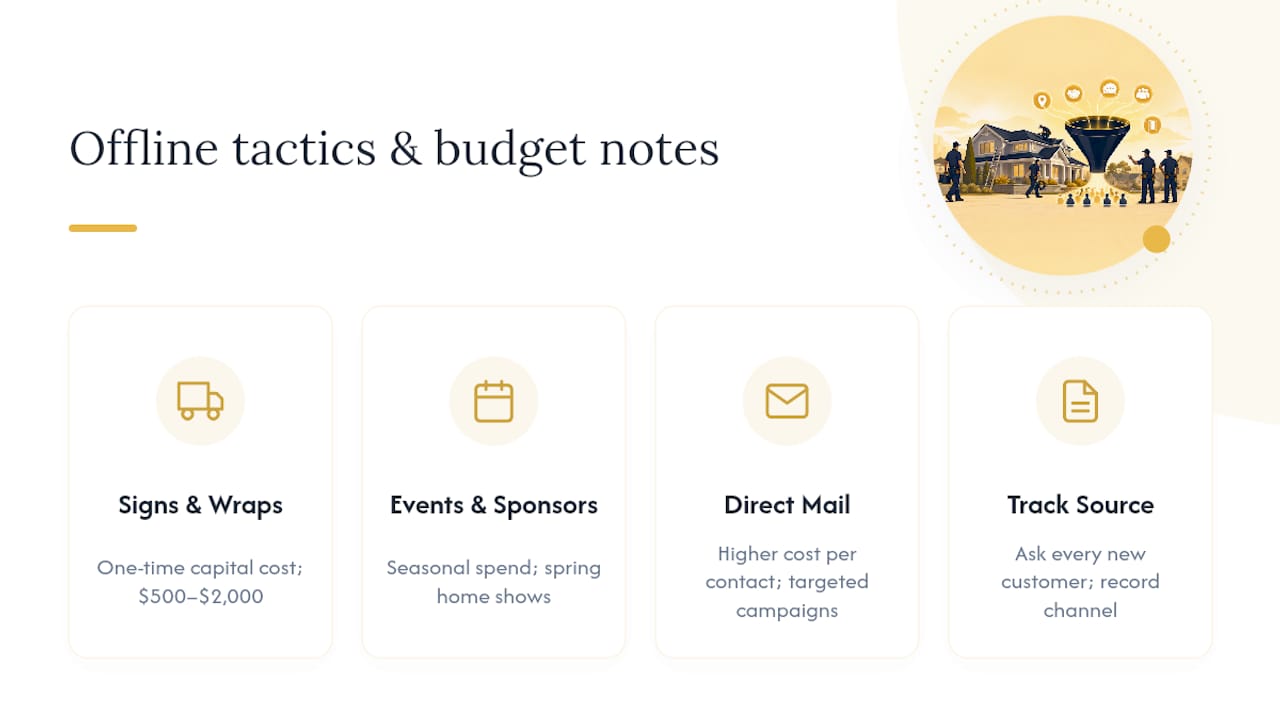
Yard signs and truck wraps carry a one-time cost but produce ongoing local impressions for years, which makes them one of the better cost-per-impression tactics available once you calculate the math over their lifespan. Budget them as a capital expense, not a monthly line item, and expect $500 to $2,000 depending on vehicle count and sign quantity.
Local events, home shows, and sponsorships of community sports teams work best for contractors targeting a specific neighbourhood or municipality rather than a wide service area. Budget these seasonally rather than monthly, since most home shows cluster in spring, and treat the cost as a lead-generation and brand-visibility line rather than expecting an immediate CPL comparable to digital ads.
Direct mail still performs for contractors with a defined service radius, especially for exterior trades running seasonal promotions. It’s more expensive per contact than digital outreach, so reserve it for targeted campaigns, a storm-damage area, a new subdivision, rather than blanket coverage.
Fold all of this into your existing percent-of-revenue band rather than treating it as a separate budget. Track offline the same way you track digital: ask every new customer how they heard about you, and record it.
Author perspective: common mistakes and a behavioural nudge
Owners buy ads early because ads feel like action, while fixing a broken quote form feels like admin. That instinct is backwards; it pays an ad platform to send traffic to a leak. Run a 90-day baseline with capture fixes in place before you scale spend, and let the numbers, not the impulse, decide what comes next.
— OnLead
How OnLead can execute your contractor budget into booked jobs
Building the budget is the easy part. Turning it into booked jobs is where most contractors stall, either because they don’t have the time to manage Google Ads and Local Services Ads properly, or because the website behind those ads still leaks leads. Some agencies focus specifically on contractors, offering campaigns for trades including HVAC, plumbing, electrical, roofing, and general contractors, and aim to launch campaigns quickly with direct management by owners or founders rather than handing off to an account rep.
If your capture systems need work first, start with web design built for contractors. If they’re solid and you’re ready to add paid volume, Local Services Ads management is usually the fastest lever. Either way, the starting point is the same: get a free audit and see exactly where your current setup is losing leads before you commit another dollar to ads.
Sources
For deeper benchmarks and worked examples behind the figures in this guide, consult ProTradeHQ’s staged budget breakdown, BSPKN’s construction marketing budget benchmarks, FreeAgency’s calculator and case studies, and Contractor Guide Pro’s channel cost benchmarks. Each covers a different piece of the budgeting puzzle in more technical depth than fits here.
- Contractor marketing budget: What to spend first | ProTradeHQ
- Construction marketing budget: How much to spend in 2026 | BSPKN
- Contractor marketing budget: How much to spend in 2026 - Contractor Guide Pro
FAQ
What is the 3-3-3 rule in marketing?
There’s no single agreed definition of a “3-3-3 rule” specific to contractor marketing, and it isn’t a framework this guide’s research supports with a firm figure. Treat any source claiming a precise 3-3-3 formula with caution unless it names a clear source.
Should I cut my marketing budget during slow seasons?
Reduce paid ad spend during predictably slow months, but keep local SEO, review requests, and follow-up sequences running year-round, since those build the pipeline that pays off once demand picks back up.