
Stop Ad Pixels: Cookie Consent Fixes for Contractors in Canada

Most Canadian websites running analytics or advertising cookies need opt-in consent before those cookies load, not after. PIPEDA sets the baseline nationally, and Quebec’s Law 25 adds stricter, separate consent rules for anyone with Quebec visitors. The practical fix is simple: block non-essential cookies until a visitor actively agrees. Also, check whether CASL and CRTC rules apply if your site installs any tracking scripts that behave like programs.
TL;DR:
- Only cookies used for marketing, advertising, or tracking that could identify users require explicit opt-in consent, while essential and functional cookies often do not.
- Quebec’s Law 25 mandates purpose-specific, separate consent requests with plain language, especially for traffic from Quebec, making bundled “accept all” options non-compliant.
- Consent must be meaningful, clearly explaining the purpose, parties involved, risks, and consequences, with records kept of all consent interactions including timestamps.
- Cookies should be gated with technical controls so scripts for analytics or ads load only after user consent, not just hidden behind banners or pre-loaded on page load.
- Most violations stem from scripts firing before consent and vague purpose descriptions; proper documentation and testing are critical for compliance.
Table of Contents
- Which Canadian cookie consent laws apply to your website?
- Which cookies actually need consent?
- What does “meaningful consent” actually require?
- How do you build a compliant cookie banner?
- Do Quebec visitors change what you need to build?
- What are the most common cookie consent mistakes?
- What contractor websites should prioritise first
- Build a compliant site without the guesswork
- Where to check the primary rules yourself
- Sources
- FAQ
Which Canadian cookie consent laws apply to your website?
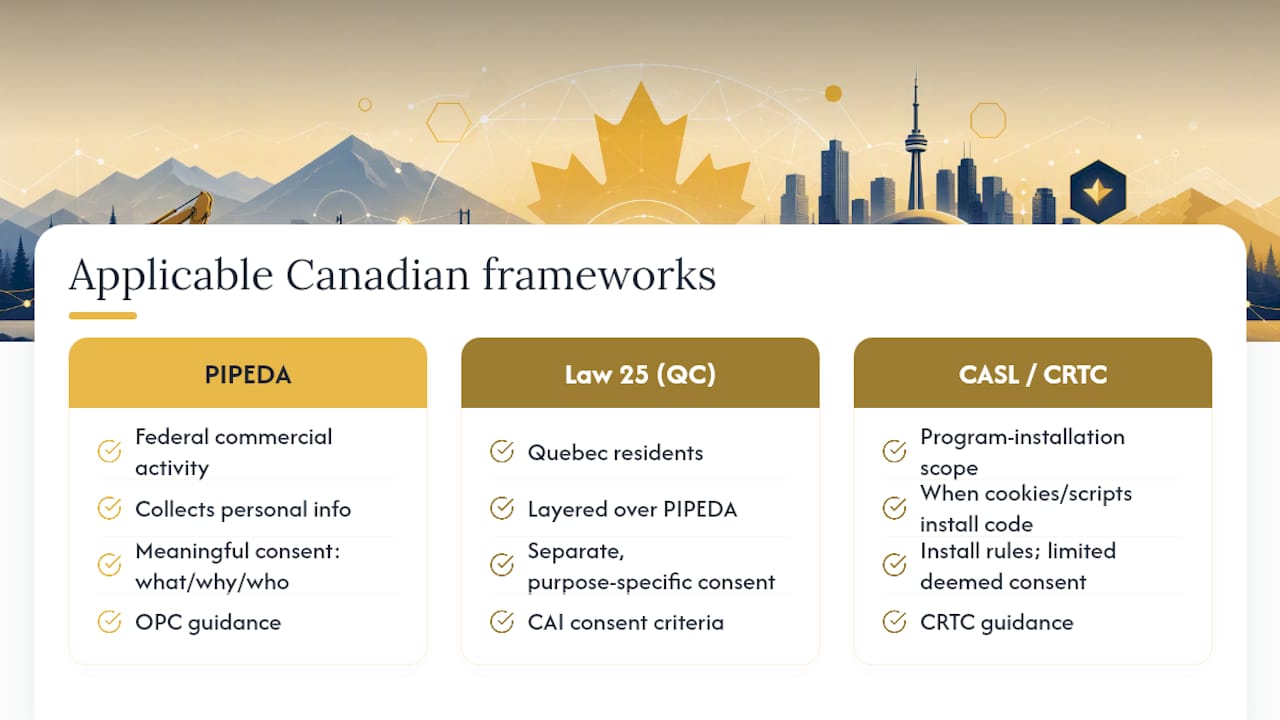
Canada doesn’t have one single “cookie law” the way the EU has the ePrivacy Directive. Instead, three overlapping frameworks govern cookie consent Canada wide, and knowing which one to check depends on what you’re actually asking.
PIPEDA is the federal baseline for any organization collecting personal information during commercial activity, including through cookies. Its consent principle requires that people understand what’s being collected, why, and by whom, before it happens. The Office of the Privacy Commissioner of Canada’s guidelines on meaningful consent spell out exactly what that means in practice, and it’s the document you’d point a developer to first.
Quebec’s Law 25 operates on top of PIPEDA for Quebec residents, and it’s considerably stricter. The Commission d’accès à l’information (CAI) requires consent requests to be presented separately from other terms, with clear purpose-by-purpose explanations rather than a single bundled checkbox. Its criteria on consent validity are the authoritative reference if any share of your traffic comes from Quebec.
CASL and the CRTC enter the picture only when a cookie or script functions like a computer program being installed on a user’s device. CRTC guidance on installing programs explains that some tracking technologies fall under CASL’s program-installation rules, and deemed consent by conduct doesn’t apply if someone has disabled cookies or JavaScript. For most contractor websites this is a narrow edge case, but it’s worth knowing which regulator, OPC, CAI, or CRTC, actually governs the question you’re asking before you go looking for an answer in the wrong document.
Which cookies actually need consent?
Not every cookie carries the same legal weight. Regulators generally sort them into four practical categories, and only some genuinely need opt-in treatment.
- Strictly necessary cookies keep the site functioning (login sessions, shopping cart contents, load balancing). These typically don’t need consent because the site can’t work without them.
- Functional cookies remember preferences like language or region. Low risk, but best disclosed rather than assumed.
- Analytics cookies track visitor behaviour for measurement. The OPC’s guidance on online behavioural advertising treats these as needing at minimum a clear opt-out, and often opt-in when data is combined across sites or linked to identifiable profiles.
- Marketing and ad cookies (retargeting pixels, third-party ad networks) carry the highest expectation of express, opt-in consent, since they build behavioural profiles used to target ads.
Implied consent can work for low-sensitivity functional cookies where the purpose is obvious to a reasonable person. Anything touching advertising, cross-site tracking, or data that could identify someone, including IP addresses in certain contexts, calls for express consent instead.
What does “meaningful consent” actually require?
The OPC’s meaningful consent standard isn’t a checkbox exercise. It requires four things to be genuinely communicated: the purpose of collection, who the parties are (including any third-party ad networks receiving data), the consequences of consenting or refusing, and any real risks involved.
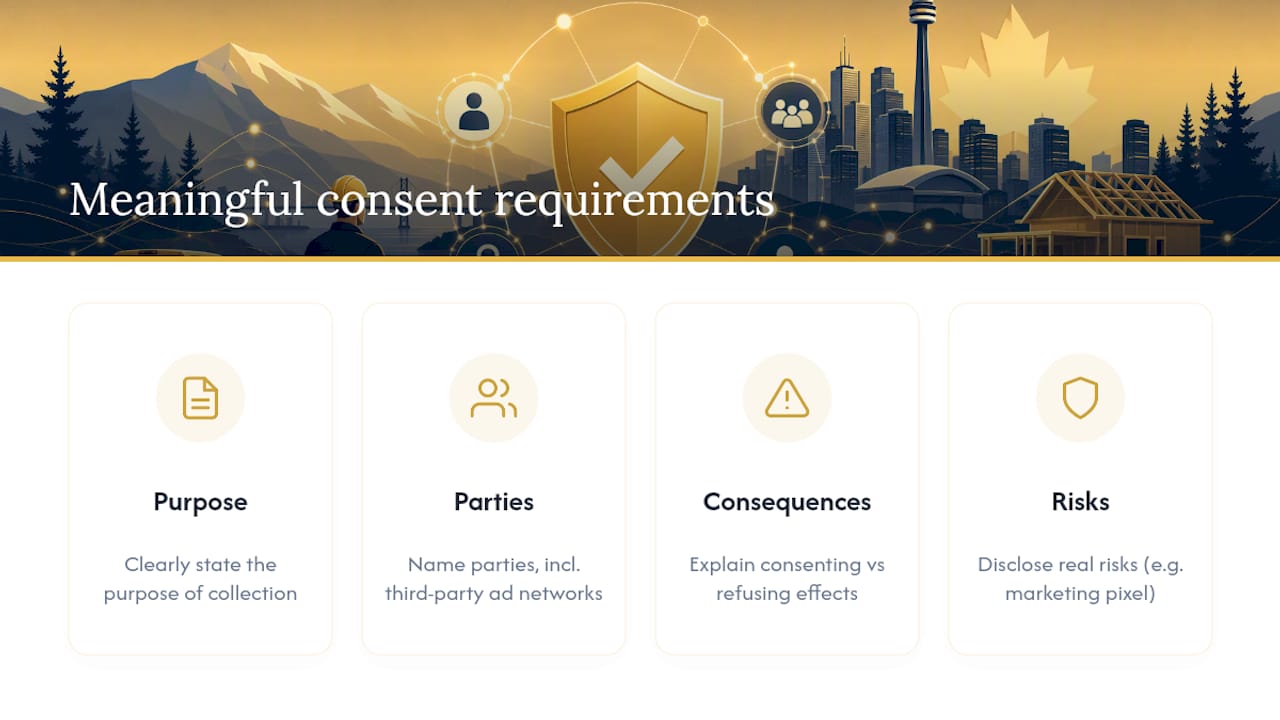
Sensitivity drives the consent type. Low-risk, expected uses can sometimes rely on implied consent. But once there’s meaningful residual risk, say, a marketing pixel sharing browsing history with a third-party platform, the OPC’s position is that express consent is the appropriate standard, not an assumption based on continued browsing.
Recordkeeping matters more than most site owners expect. If the OPC or CAI ever asks how consent was obtained, you need a timestamped log showing what a visitor saw, what they clicked, and what version of your cookie banner was live at that moment. A consent management platform (CMP) typically handles this automatically, but if you’re running something custom, build the log yourself before launch, not after a complaint arrives.
Withdrawal has to be as easy as giving consent in the first place. That means a visible, persistent way to change cookie preferences after the initial banner disappears, usually a footer link or a small floating icon, and it means your backend actually respects that change rather than continuing to fire the same scripts anyway. The OPC also recommends avoiding techniques users can’t meaningfully control, like device fingerprinting or so-called zombie cookies that regenerate after deletion. If a technique can’t be turned off by the user, it can’t be made compliant by better wording.
How do you build a compliant cookie banner?
Getting this right is mostly a sequencing problem: nothing non-essential should load before someone clicks something.
- Design the banner with real choices. Include clear “Accept,” “Reject,” and “Manage Preferences” options with purpose-level toggles, not a single “Got it!” button that quietly accepts everything.
- Never pre-tick anything non-essential. Marketing and analytics toggles should default to off. A pre-checked box isn’t consent under PIPEDA or Law 25, it’s an assumption regulators have already flagged as invalid.
- Gate scripts technically, not just visually. Use a tag management system to hold third-party scripts (ad pixels, analytics tags) in a paused state until consent fires. Hiding a banner without blocking the underlying script is the single most common failure point.
- Run a cookie scan and build an inventory. Free and paid scanning tools will crawl your site and list every cookie currently firing. Document each one’s purpose, the party that sets it, and how long it persists.
- Set minimal retention periods. Don’t keep consent logs or cookie data longer than you can justify. Shorter retention windows reduce your exposure if a breach or audit ever happens.
- Test the full flow before launch. Check first-visit behaviour, the reject path, the withdrawal path, and mobile browsers separately, since consent scripts sometimes behave inconsistently across devices.
Pro Tip: Test your banner in an incognito window with browser dev tools open, watching the network tab. If you see any ad or analytics request fire before you’ve clicked “Accept,” your gating isn’t actually working, no matter how good the banner looks.
Do Quebec visitors change what you need to build?
If any meaningful share of your traffic comes from Quebec, treat cookie consent Canada wide rules as a floor, not the finish line. Law 25 expects consent requests presented separately from your general terms or privacy policy, with each purpose (analytics, advertising, functional) getting its own clear yes or no, not one bundled “accept all” button.
Language matters too. A French-language version of your banner isn’t optional politeness, it’s part of meeting the CAI’s expectation that consent requests be clear and understandable to the person giving them. Practically, that means purpose-level toggle buttons instead of a single switch, plain French copy explaining each category, and a Quebec-specific banner version if your CMP supports geo-targeting. Bundling everything into one accept button might pass in the rest of Canada; in Quebec, it’s a documented compliance gap.
What are the most common cookie consent mistakes?
The same handful of errors show up on nearly every non-compliant site. Scripts fire on page load before any consent decision exists. Purpose descriptions stay vague (“we use cookies to improve your experience”) instead of naming what’s actually being collected and why. Withdrawal is technically possible but buried three menus deep, or doesn’t actually stop the scripts once clicked.
Both the OPC and Quebec’s CAI have made clear their enforcement posture centres on meaningful consent and transparency, not technical box-checking. If your banner looks compliant but your scripts fire regardless of the user’s choice, that’s precisely the gap regulators focus on during a complaint review.
Preparing for scrutiny doesn’t require a legal team. Keep your cookie inventory current, retain consent logs with timestamps, and document why each cookie exists and how long it’s retained. If a complaint or audit ever arrives, that paper trail is what separates a quick resolution from a drawn-out one.
What contractor websites should prioritise first
Most trade and contractor websites don’t need a legal department to get this right, they need the right order of operations. Block marketing and ad trackers first, since that’s where regulatory risk concentrates, while leaving core functionality (booking forms, click-to-call, chat widgets) untouched. Analytics can often run on implied consent if the purpose is disclosed plainly, but retargeting pixels for Google Ads and Meta campaigns should wait for an actual click.
When OnLead hands over a completed website, the cookie inventory and consent configuration go with it, not as an afterthought bolted on later. That matters because a lot of contractor sites we’ve reviewed had tracking pixels firing on load with no banner at all. Compliance and ad measurement aren’t actually in conflict, gated analytics still captures conversion data once a visitor opts in, it just captures less of the traffic that never consents in the first place.
— OnLead
Build a compliant site without the guesswork
Retrofitting consent onto an existing contractor website usually means untangling scripts a previous developer never documented. Consent layers should be built in from the start, so websites come with a working cookie banner, purpose-level gating, and an inventory the next developer can read. Clients often work directly with leadership rather than a support queue, and most builds launch quickly, with no long-term contract locking you in afterward.
If your site currently loads Google Ads or Meta pixels before anyone clicks anything, that’s a fix worth making regardless of traffic volume. Onlead’s website and local marketing services cover the build, the consent setup, and the ongoing SEO that depends on clean data. Request a free audit and find out exactly what your current site is firing before a visitor ever says yes.
Where to check the primary rules yourself
Bookmark the OPC’s consent guidelines, the PIPEDA statute text, CRTC’s program-installation guidance, and the CAI’s Law 25 consent criteria.
Sources
- Guidelines for obtaining meaningful consent - Office of the Privacy Commissioner of Canada
- CRTC guidance on installing programs and implied consent
- Commission d’accès à l’information — Criteria on consent validity (Quebec)
FAQ
Is it legal to force people to accept cookies to use a website?
No. Forcing acceptance with no reject option, or hiding the “reject” choice behind extra clicks, undermines the meaningful consent standard the OPC requires. Essential cookies needed to run the site are the exception, since the site genuinely can’t function without them.
Is cookie consent legally required in Canada?
Yes, for most analytics and advertising cookies, though the exact form depends on sensitivity and where your visitors live. PIPEDA sets the national baseline while Quebec’s Law 25 adds stricter, separate consent requirements for Quebec residents specifically.
What are the main regulations governing cookie consent in Canada?
PIPEDA governs consent nationally for commercial data collection, Quebec’s Law 25 adds formal, purpose-by-purpose consent rules through the CAI, and CASL’s CRTC-enforced program rules apply narrowly when a cookie behaves like an installed program. Each regulator answers a different question, so check the one that matches your actual concern.
Does OnLead help with cookie consent compliance directly?
Onlead builds websites with cookie banners and script gating configured as part of the website build, rather than as a separate add-on. Pricing is quoted after a free audit since every site’s tracking setup is different.
Can implied consent ever be enough for cookies?
Yes, for low-risk, expected uses like basic functional cookies where the purpose is obvious to a reasonable visitor. Anything involving advertising, cross-site tracking, or data that could identify someone calls for express, opt-in consent instead.